Impact of Snapback Mechanism on Business Conditions and Stock Market Performance in Iran’s Agriculture, Sugar, Food and Pharmaceutical Industries

Document Type : Original Article

Authors
1 Department of Management, Faculty of Management, Industrial Management, Islamic Azad University, E-Campus, Tehran, Iran.
2 Department of Economics and Islamic Banking, Faculty of Economics, Kharazmi University, Tehran, Iran.
3 Department of Accounting, Kashan Branch, Islamic Azad University, Kashan, Iran.
Abstract
International sanctions have significantly affected Iran’s economic structure by imposing financial, monetary, and trade restrictions on productive and industrial sectors. The Snapback Mechanism, as a key instrument for the reimposition and intensification of international sanctions, can further disrupt supply chains, production processes, and industrial competitiveness. This study examines the impact of the Snapback Mechanism on the agriculture, sugar, food, and pharmaceutical industry indices in Iran. Annual data for 2011–2025 were analyzed using the Autoregressive Distributed Lag (ARDL) model. The empirical findings indicate that the activation of the Snapback Mechanism has a significant negative impact on the selected industry indices through increased production costs, exchange rate volatility, higher prices of imported inputs, and restricted access to essential raw materials and advanced technologies. The results further reveal reduced production flexibility, greater dependence on domestic resources, and constraints on industrial capacity expansion in the long run. Sanctions have also weakened the competitive position of the targeted industries and undermined supply chain security and production stability. The study concludes that the effects of the Snapback Mechanism extend beyond short-term disruptions and pose significant long-term challenges to industrial development and economic resilience. To mitigate these effects, policymakers should strengthen domestic production of strategic inputs, diversify import channels, develop alternative financial and trade mechanisms, improve logistics infrastructure, and implement targeted support policies for vulnerable industries. These measures can enhance production sustainability, strengthen supply chain resilience, and improve the capacity of Iran’s industrial sectors to withstand external economic shocks.

Graphical Abstract

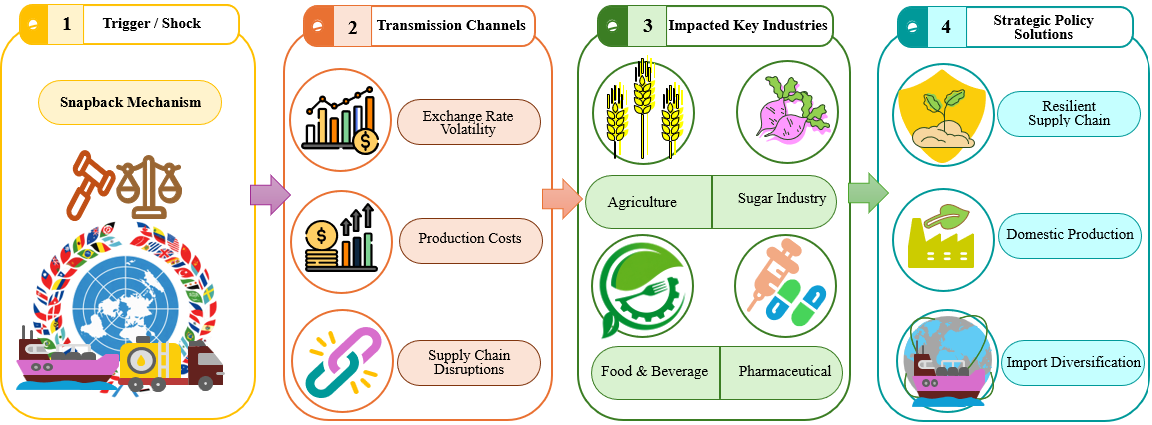
Impact of Snapback Mechanism on Business Conditions and Stock Market Performance in Iran’s Agriculture, Sugar, Food and Pharmaceutical Industries
Keywords

[1]      S. A. Razavi, M. Nasr Esfahani, Political Strategic Studies, 2020, 9(35), 101-134. https://doi.org/10.22054/qpss.2020.42777.2320
[2]      S. A. Razavi, S.Pirani, Petroleum Business Review, 2019, 3(4), 28-36. https://doi.org/10.22050/pbr.2019.119151
[3]      P. Fasahat, M. Kakouei Nejad, Sugar Beet, 2021, 37(1), 131–138.
[4]      S. A. Razavi, A. K. Manshad, L. Kashani, Energy Strategy Reviews, 2026, 65, 1022261-30. https://doi.org/10.1016/j.esr.2026.102226
[5]      V. Khashaei, M. Ghasemi Shams, M. Akbari, M. Ebrahimi,. Business Management, 2023, 15(1), 85–110.
[6]      A. Ismailzadeh, S. Ehdai, M. Akhavan Anvari, Agricultural Economics, 2025, 13(1) 165–192.
[7]      S. R. Safavi Mirmohalleh, M. Ramazanyan, E. Pour, Management Research in Iran, 2024, 28(3), 1–29.
[8]      L. Zamanian Far, Y. Pakniat, S. Seraj, Passive Defense, 2024, 15(2), 27–48.
[9]      M. Rezvani, M. Pendar, E. Vafaee, Economic Policies and Research, 2023, 2(3), 87–113.
[10]    A. Dadres Moghaddam, S. M. Hosseini, M. Norouziyan, M, Agricultural Economics and Development, 2021, 29(4), 151–179.
[11]    A. Javaheri, M. Pendar, E. Vafaee, Iranian Journal of Agricultural Economics and Development Research, 2022, 53(2), 553–566.
[12]    A. Eskanderi Pour, O. Setari, P. Pas, Iranian Journal of Agricultural Economics and Development Research, 2021, 52(4), 863–878.  
[13]    M. R. Mohaammadvand Nahidi, L. Sadeghi, , Economics and Accounting, Tabriz, 2015.
[14]    V. Azizi, N. Mehregan, G. Yavari, Iranian Journal of Agricultural Economics and Development Research, 2015, 46(1), 107–119.
[15]    S. K. Afesorgbor, L. Kornher & F. G. Santeramo, The World Economy, 2025, 48(8), 1942-1956.
[16]    Organisation for Economic Co-operation and Development, 2023. Sanctions and global supply chains. OECD Publishing.https://www.oecd.org
[17]    Eurasian Development Bank,. Eurasian Development Bank, 2023. https://eabr.org
[18]    A. Lukyanova, A. Zeynalov, Russian Agricultural Industry Under Sanction Wars. arXiv preprint arXiv:2211.09205, 2022.
[19]    United Nations Conference on Trade and Development (UNCTAD), Health and Biotechnology Policy Review – STIP Review: Issues 01/Health. United Nations, 2021.
[20]    S. Zartab, N. N. Koopaei, H. Abbasian, M. Nassiri Koopaei, Journal of Pharmaceutical Policy and Practice, 2020, 13, 50-78 .