Risk Management in Gas Flare Pipeline Construction Projects: A Case Study of Kimia Pars Middle East Petrochemical Complex

Document Type : Original Article

Authors
Department of Oil & Gas Contracts and Management, Tehran Faculty of Petroleum, Petroleum University of Technology (PUT), Abadan, Iran.
Abstract
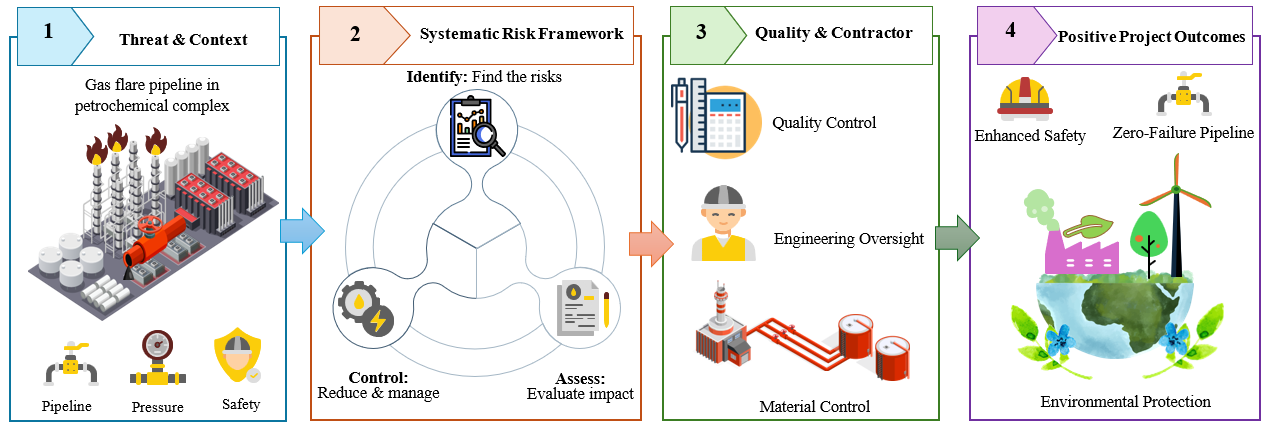
Failure of high-pressure gas flare pipelines can pose severe threats to human safety, civil infrastructures, and the environment. Therefore, implementing effective risk management strategies is essential to reduce the probability and impact of such undesirable events. This study focuses on risk management in the construction of gas flare transmission pipelines, where various critical risk factors may emerge throughout different stages of the construction process. A systematic risk management approach is applied to identify, assess, and control potential risks associated with pipeline construction activities. Quality control practices are considered as one of the fundamental tools for risk mitigation, enabling independent evaluation of construction processes, compliance with technical requirements, and verification of planned quality standards. The contractor plays a key role in ensuring the proper application of construction technologies and the quality of materials throughout the project lifecycle while assuming responsibility for preventing potential failures in execution and implementation. The findings highlight the importance of proactive risk identification and management in gas flare pipeline construction projects. Effective risk management practices can significantly improve project safety, enhance construction quality, reduce the likelihood of operational failures, and minimize environmental and social consequences. The proposed approach provides valuable insights for project managers and contractors involved in complex petrochemical infrastructure projects.

Graphical Abstract

Risk Management in Gas Flare Pipeline Construction Projects: A Case Study of Kimia Pars Middle East Petrochemical Complex
Keywords

 
[1]      T. Aven. Risk assessment and risk management, 2016 , 253(1), 1–13. https://doi.org/10.1016/j.ejor.2015.12.023
[2]      N. Khakzad, F. Khan, & P. Amyotte. Reliability Engineering & System Safety. 2013, 104(3), 36–44.
[3]      C. Chapman & S. Ward. How to manage project opportunity and risk: Why uncertainty management can be a much better approach. Wiley, 2011.
[4]      Project Management Institute, A guide to the project management body of knowledge (PMBOK guide) (7th ed.). Project Management Institute, 2021.
[5]      P. Zou, G. Zhang & J. Wang, International Journal of Project Management, 2007, 25(6), 601–614. https://doi.org/10.1016/j.ijproman.2007.03.001
[6]      S. Mannan, Lees' loss prevention in the process industries. Butterworth-Heinemann, 2012.
[7]      Y. Bai & Q. Bai, Subsea engineering handbook. Elsevier, 2014.
[8]      L. Cox, Risk Analysis, 2008, 28(2), 497–512. https://doi.org/10.1111/j.1539-6924.2008.01030.x
[9]      T. Aven, Reliability Engineering & System Safety, 2016, 134(23), 83–91.
[10]    C. A. Ericson, Hazard analysis techniques for system safety. Wiley, 2015.
[11]    H. C. Liu, L. Liu & N. Liu, Expert Systems with Applications, 2013, 40(2), 828–838.
[12]    J. N. Warfield, IEEE Transactions on Systems, Man, and Cybernetics, 1974, 4(1), 81–87.
[13]    M. Jafari, Comprehensive risk assessment and management of pipeline systems. Journal of Loss Prevention in the Process Industries, 2009, 22(4), 533-539.
[14]    A. Farahani & K. Khalili-Damghani, H. Didehkhani, A. Sarfaraz & M. Hajirezaie, IEEE Access, 2021, 9, 88767-88781.
[15]    R. Ghavidel & M. Shamskia, Risk analysis of gas transmission pipeline projects using FMEA and AHP, 2019.
[16]    X. Li, Z. Han, R. Zhang, R. Abbassi, D. Chang‏,  Journal of Loss Prevention in the Process Industries, 2020, 66, 1041541-9.
[17]    A. Ishikawa, M. Amagasa, T. Shiga, G. Tomizawa, R. Tatsuta, & H. Mieno. Fuzzy Sets and Systems, 1993, 55(3), 241–253.